
Somebody on the Sioux Falls subreddit put it about as plainly as it gets: “Any local siding companies that do LP siding? I feel like everyone I find only does vinyl.”
That’s the conversation in a lot of driveways around here. Vinyl’s what most of the houses on the block have, it’s what the first quote comes back with, and it’s fine right up until a June storm rolls through and the west wall looks like somebody went at it with a ball-peen hammer.
So here’s the straight version of what holds up in South Dakota and what doesn’t. We install all four of the common options (SmartSide, Hardie, vinyl and steel), so we don’t need you to pick any one of them.
What South Dakota does to siding
Siding out here doesn’t wear out the way it does in a brochure. It gets hit, it gets frozen, and it gets baked, sometimes in the same week.
232major hail events (1 inch or bigger) in South Dakota in 2025, seventh in the U.S.
110°FSioux Falls record high, set in 1936 and tied in 1988
−42°FSioux Falls record low, February 1899
That’s a 152-degree spread between the records at a single weather station. Siding expands and shrinks with every swing, water gets into any gap it can find, and then it freezes and makes the gap bigger.
And hail is the big one. South Dakota isn’t Texas, but it’s not far behind the states people think of as hail country:
Major hail events by state, 2025
Hailstones 1 inch or larger, top 10 states
| State | Events |
|---|---|
| Texas | 902 |
| Kansas | 375 |
| Oklahoma | 369 |
| Nebraska | 315 |
| Missouri | 253 |
| Colorado | 244 |
| South Dakota | 232 |
| Tennessee | 216 |
| Illinois | 167 |
| Arkansas | 154 |
Put those together and the question isn’t really “what looks nicest.” It’s what takes a hit, shrugs off a freeze and still looks decent in fifteen years.
The four real options, side by side
| LP SmartSide | James Hardie | Insulated vinyl | Steel | |
|---|---|---|---|---|
| What it is | Engineered wood | Fiber cement | PVC with foam backing | Galvanized steel |
| Hail | Best of the four in impact tests | Can chip or dent | Most likely to crack | Dents, rarely cracks |
| Cold | Doesn’t care | Brittle when handled cold | Brittle when hit cold | Doesn’t care |
| Weight | Light (16-ft boards) | Heavy (12-ft boards) | Very light | Light |
| Paint | Repaint ~15–25 yrs | Repaint ~15–25 yrs | Never | Never |
| Warranty | 5/50-yr limited | 30-yr non-prorated | Lifetime limited, usually | Varies by maker |
| Installed cost / sq ft | $4–9 | $5–13.50 | $3–12 | $4–8 |
Cost ranges are national figures from Fixr and HomeAdvisor, so treat them as a starting point. Your house, your trim and how much of the old stuff has to come off move the number more than the material does. Our siding page has more on what goes into a quote.
Why SmartSide usually comes out on top here
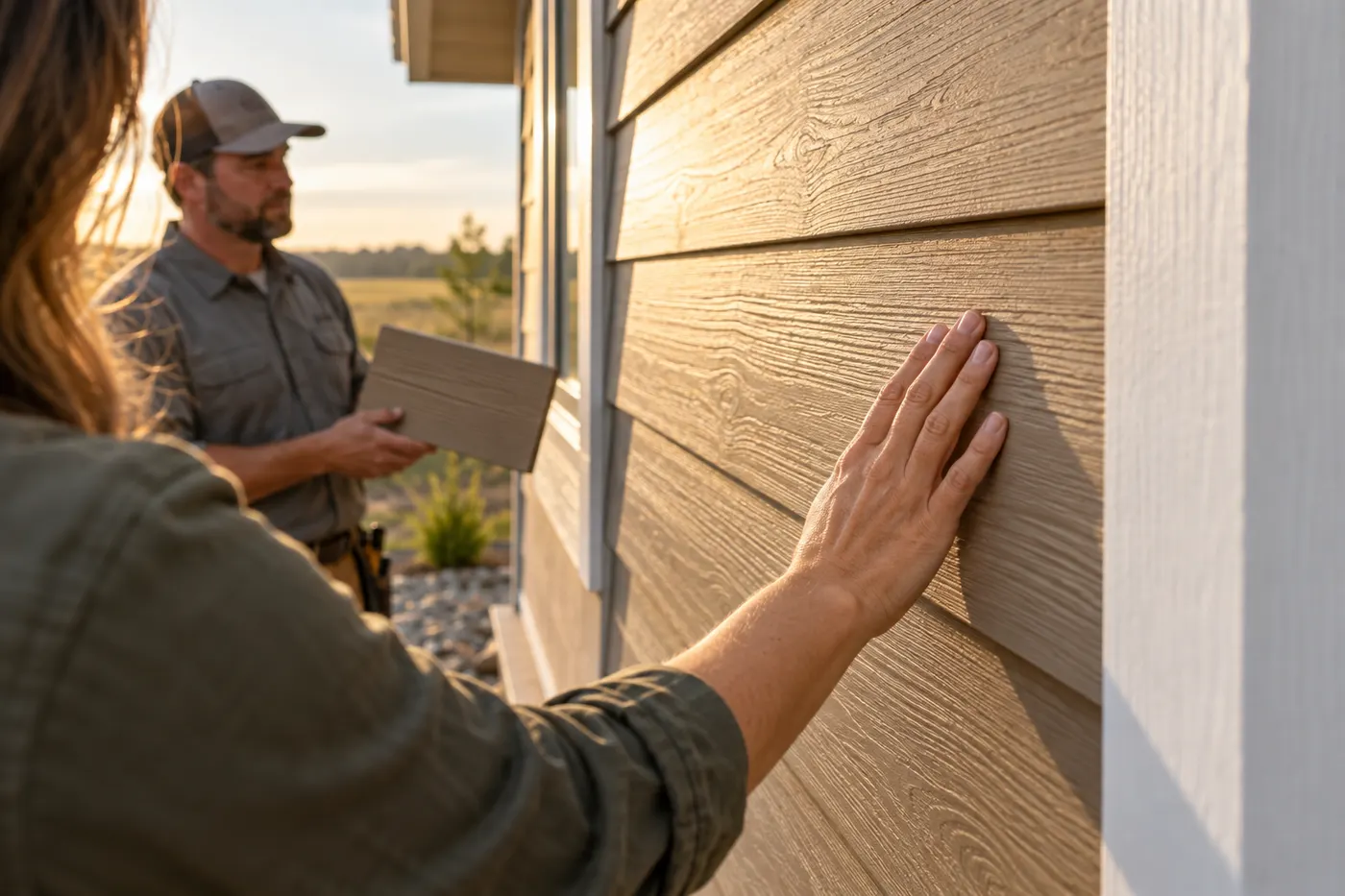
It takes a hit. In 2017 LP paid Texas Tech’s wind and debris lab to fire hail at siding. SmartSide showed no sign of impact from 1.75-inch hail at 81 mph. Fiber cement dented at the same size and a slower speed, and vinyl fractured at 1.25 inches, smaller than a golf ball. That’s the manufacturer’s test, so take it with a grain of salt. But it lines up with what you see on the west side of houses after a storm, and LP backs it with a hail warranty (LP, 2017).
It’s treated all the way through. LP’s SmartGuard process soaks the wood strands in resins, waxes and zinc borate, which is what keeps out moisture, rot and termites (LP).
It’s light enough to put on right. The boards run 16 feet, so you get fewer seams, and LP rates them up to 39% lighter than fiber cement per square foot. Lighter boards mean fewer cracked pieces and a crew that isn’t fighting the material on a ladder in a 30 mph wind.
The warranty’s real. Primed SmartSide carries a 5/50-year limited warranty. That’s five years of full labor and materials, then prorated coverage on the board out to 50. ExpertFinish prefinished boards add 15 years on the finish (LP).
We’re a certified LP SmartSide installer, and that’s not just a badge for the truck. It’s the reason we’d tell you about the next part.
SmartSide’s honest weak spot
You’ll find people online who hate it. One carpenter on Reddit summed up the complaint: “Every end swells… sure, they’ve reformulated, but it’s still OSB.”
Here’s what’s actually going on. SmartSide doesn’t swell on the face. It swells at cut ends that weren’t sealed, and at boards that sit too close to a roof or the ground, where they soak up snowmelt all winter. LP’s own instructions spell it out (LP install guide):
- Seal every exposed cut. LP says to seal all of them and doesn’t recommend a quick spray-on coat.
- Keep a 1-inch gap above any roofline, like where a wall meets the garage roof.
- Keep it 6 inches above finished grade, which in South Dakota means above where the snow piles up against the house.
- Leave a 3/16-inch gap at trim and butt joints, then seal it.
Skip those and you’ll get the swollen, wavy boards people post pictures of. Do them and SmartSide is about as low-drama as siding gets.
Quick test when you get quotes: ask the crew what they do with cut ends and what gap they leave at the roof. If they hesitate, keep shopping.
And about that old class action: it was over LP’s Inner-Seal siding, installed before 1996. That’s a different product made a different way. It’s fair to know about, but it’s not today’s SmartSide.
When we’d steer you somewhere else
James Hardie, if fire’s your worry or you love the look. Fiber cement won’t burn, and some insurers like that. Hardie sells an HZ5 line built for “freezing temperatures, extreme seasonal temperature variations, and snow and ice” (James Hardie), which is the line to use out here. It carries a 30-year non-prorated warranty, plus 15 years on the ColorPlus finish (Hardie FAQ). The trade-offs: it’s heavy, it’s brittle when handled in the cold, and a rushed crew will chip it.
Insulated vinyl, if the budget’s tight or you never want to paint. Get the thick stuff. Builder-grade vinyl runs about 0.040 inch thick, and premium panels around 0.046 to 0.048 (NerdWallet via KING 5). Foam-backed panels feel solid and add a little R-value. They’ll still crack in a bad hailstorm, but replacing a few panels isn’t a big job.
Steel, if you’re done painting forever. One Midwest homeowner on Reddit said it well: “we get a ton of hail that shreds the neighbors’ vinyl.” Steel won’t crack. It can dent, though, and dents are permanent.
What it comes down to
For most houses in Sioux Falls, Watertown, Aberdeen and the towns in between, SmartSide is the best mix of hail resistance, price and looks. But the material is maybe half the result. The other half is whether the crew seals the cuts, flashes the windows and leaves the gaps.
If you’re weighing this against what it’s worth at resale, read the real ROI of new siding. If you’re already picking colors, here’s what’s going up on houses this year. And if a storm already got to the siding, what hail damage looks like walks through what to check first.
We’ll bring SmartSide, Hardie and vinyl samples out to the house, price whichever ones you want, and tell you which we’d put on our own.
Questions we get about this
Is LP SmartSide just OSB?
It starts as wood strands like OSB, but it's treated all the way through with LP's SmartGuard process (resins, waxes and zinc borate) and has a resin-saturated overlay on the face. The 1990s LP siding that ended in a class action was a different product. The real-world failures you'll read about today are almost always unsealed cut ends or boards that sit too close to the roof or the ground.
Does hail damage LP SmartSide?
LP warrants SmartSide against hail damage. In a 2017 test LP commissioned at Texas Tech, it showed no sign of impact from 1.75-inch hail at 81 mph. Bigger stones can still dent it, and no siding is hail-proof. But it's the most impact-tolerant of the common options.
Is vinyl siding OK in South Dakota?
Yes, if you buy a thick or insulated panel and accept that it's the most likely to crack in a hailstorm, especially on a cold day. It's the cheapest to put on and never needs paint. Thin builder-grade vinyl (around 0.040 inch) is what gives vinyl its bad name out here.
How long does LP SmartSide last?
The substrate carries a 50-year limited warranty, with full labor and materials coverage for the first five years. Prefinished ExpertFinish boards add a 15-year finish warranty. Plan on a repaint somewhere in the 15-to-25-year range, sooner on the south and west walls.
Do woodpeckers go after SmartSide?
Sometimes, and it comes up a lot online, mostly from shed owners. Woodpeckers will peck at more than one kind of siding. If you already have a woodpecker problem on the house, tell us at the estimate and we'll talk through Hardie or steel for that wall.
Sources
- Insurance Information Institute: Facts + Statistics, Hail (NOAA Storm Prediction Center data, 2025)
- National Weather Service Sioux Falls: Climate quick reference (record high and low)
- LP Building Solutions: LP now warrants its engineered wood siding for hail damage (May 11, 2017)
- LP Building Solutions: Introducing LP SmartSide ExpertFinish (warranty terms)
- LP Building Solutions: LP SmartSide for homeowners (SmartGuard process)
- LP Building Solutions: SmartSide Nickel Gap installation instructions
- James Hardie: The HardieZone system (HZ5 for freeze-thaw climates)
- James Hardie: Frequently asked questions (30-year and ColorPlus warranties)
- Fixr: Engineered wood siding installation cost (updated March 2026)
- HomeAdvisor: Siding installation cost by material
- KING 5 / NerdWallet: Vinyl siding costs and thickness grades