
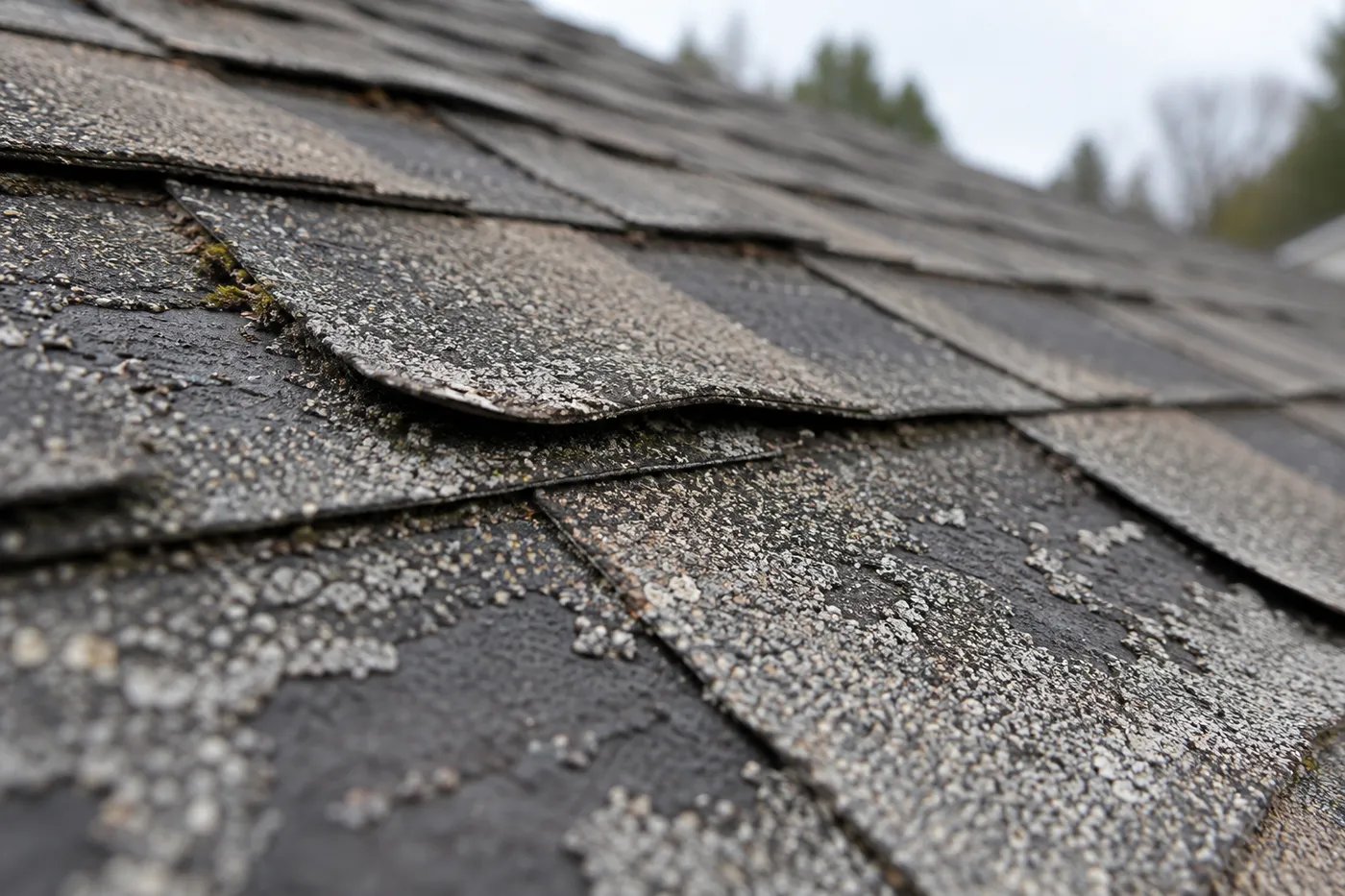
Manufacturers rate a standard architectural shingle at 25 to 30 years. Ask anyone who has been on roofs around Sioux Falls, Brandon or Harrisburg for a decade and they will tell you the real number here is closer to 17 to 22.
It isn’t that the shingles are worse. It’s that the northern plains are a harder place to be a roof.
Three things age a roof faster here
Hail. Obvious, but worth being precise about. A hailstorm doesn’t usually put a hole in a roof. It bruises it — knocks the protective mineral granules loose and leaves the asphalt mat underneath exposed to UV. The roof doesn’t leak that week. It just starts aging faster from that day on, and the bill arrives four years later. The I-29 corridor from Sioux City up through Sioux Falls, Brookings and Watertown takes this more often than almost anywhere else in the country. What that damage actually looks like is worth knowing — see what hail damage looks like on a roof.
Freeze-thaw. Between November and March a roof here can cross freezing and back a few hundred times. Every cycle works moisture into small gaps, expands it, and opens them slightly. It’s why flashing details and sealed penetrations matter more in this climate than they do somewhere with a mild winter.
Heat from below. This is the one most people don’t expect, and the one you can actually do something about.
Your attic is probably the reason
An asphalt shingle is designed to shed heat upward and be cooled from beneath by moving air. Without enough intake ventilation at the soffit and exhaust at the ridge, the attic turns into an oven, the underside of the roof cooks, and the shingles dry out and start curling years early.
If you see shingles curling, cupping or lifting at the edges on a roof that isn’t old, that’s usually heat from below rather than weather from above.
Two things follow from that:
- Ventilation is worth fixing whether or not you’re replacing the roof.
- Inadequate ventilation voids most manufacturer warranties. Plenty of people find this out at the worst possible moment. It’s why ventilation should be sized to your attic rather than guessed at.
Ice dams are a symptom, not a cause
If a ridge of ice builds along your eave every winter, that’s heat escaping into the attic, melting snow higher up the roof, and the water refreezing when it reaches the cold overhang. Everything behind that ridge backs up under the shingles.
Same root cause as the curling: the attic is too warm. Fixing insulation and ventilation usually does more for the roof’s lifespan than any upgrade to the shingle itself. The whole thing is written up in why your eave ices up every winter.
When age alone means it’s time
Age by itself isn’t a reason to replace anything. Plenty of 22-year-old roofs around here have several good years left, and we have told people exactly that.
But past twenty years it’s a reason to have someone get up there with a camera, because at that point the difference between five more good years and a winter of water damage is not something you can see from the driveway.
What to look for from the ground
- Granules collecting in the gutters or at the bottom of downspouts. A handful after a new install is normal. A steady accumulation on a roof past fifteen years is the roof telling you its remaining life.
- Shingles curling, cupping or lifting at the edges.
- A stain on a ceiling near a chimney, a wall or a vent. That’s almost always flashing, not the shingles themselves.
- Ice building along the eave every winter.
None of that means you need a roof tomorrow. All of it means it’s worth having someone look before the next hail season rather than after it.
If it does turn out to be time, what a new roof actually costs in Sioux Falls covers the money and the roofing page covers the work. The estimate is free either way, across all ten of our South Dakota-area offices.