
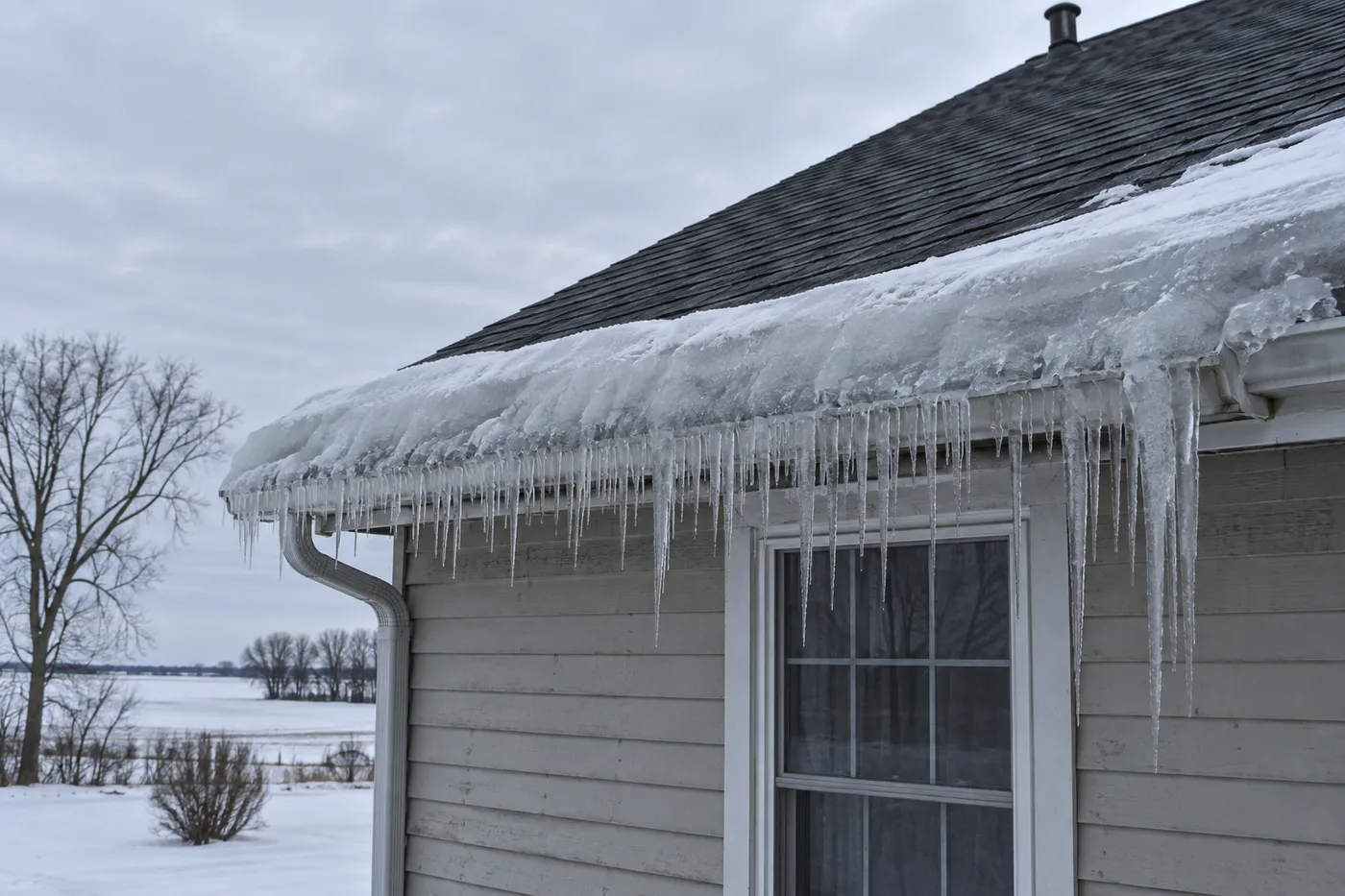
If a ridge of ice builds along the same eave every January, you don’t have a roof problem. You have an attic problem that shows up on the roof.
Understanding that changes what you spend money on, which is why it’s worth five minutes.
What’s actually happening
Snow sits on your roof. Heat leaks out of the living space into the attic and warms the underside of the deck. Snow on the upper part of the roof melts, because that part is warm from below.
The water runs down toward the eave. The overhang isn’t over heated space, so it’s at outdoor temperature, and the water refreezes when it gets there. Clogged or undersized gutters make it worse, because standing water at the eave is exactly what freezes first. Do that for a few days and you get a ridge of ice along the edge.
Now the next round of meltwater hits that ridge and stops. It pools behind it, and standing water on a roof finds its way under shingles, because shingles are designed to shed running water, not to sit in it.
That’s when it comes through a ceiling, usually along an exterior wall, usually in a room nobody was watching.
Why this region gets them badly
Eastern South Dakota is close to a worst case. Real snow that sits rather than melting off. Long stretches below freezing so the overhang stays cold. And enough sun and daytime swing to drive melt on the upper roof.
Add the housing stock — plenty of homes around Sioux Falls, Brandon and Dell Rapids built before attic air-sealing was taken seriously — and you get ice every winter on the same three houses in a block while the rest are fine.
What doesn’t fix it
Heat cable. It melts a channel through the dam, which is genuinely useful for getting you through a bad February. It does nothing about the heat loss causing it, it runs up your electric bill, and it fails in a few seasons. Manage the symptom if you need to, but don’t confuse it with a fix.
Raking the roof. Same story, plus the risk of taking granules off with the snow if you’re aggressive about it.
A new roof, by itself. Replacing shingles does not change attic temperature. The dam will form on the new roof exactly as it did on the old one. Ice-and-water barrier along the eave is genuinely worth doing, and it will stop the water reaching your ceiling — but the ice will still be there.
What actually fixes it
In this order, because it’s also the order of cost-effectiveness:
1. Air sealing. Most attic heat arrives by air leakage, not conduction — around can lights, bath fans, plumbing stacks, the attic hatch, and gaps at the top of interior walls. Sealing those is the highest-value thing you can do and it’s often the cheapest.
2. Insulation. Once air leaks are sealed, depth matters. A lot of houses in this area have settled insulation well below current recommendations.
3. Ventilation. Intake at the soffit, exhaust at the ridge, balanced so outdoor air washes the underside of the deck and keeps it near outdoor temperature. This is also what stops your shingles cooking in July, so it earns its money twice.
4. Ice-and-water barrier at the eaves, whenever the roof is next replaced. It doesn’t stop dams. It stops the dam from reaching your drywall.
How to tell which house you are
- Icicles along the eave most winters, not just after an unusual thaw
- Ice specifically over the overhang while the upper roof is clear
- A stain appearing on a ceiling near an exterior wall in late winter
- Warm spots on the roof where snow melts first, visible on a cold morning
- An attic that feels noticeably warmer than outside on a January day
If that’s your house, get someone into the attic before you spend anything on the roof. The answer is usually up there.
Ice dams are one of several ways a South Dakota winter shortens a roof’s life — how long a roof lasts in South Dakota covers the rest. If the ceiling has already stained, that’s worth looking at now rather than in spring: the estimate is free and usually same day across all ten of our offices.